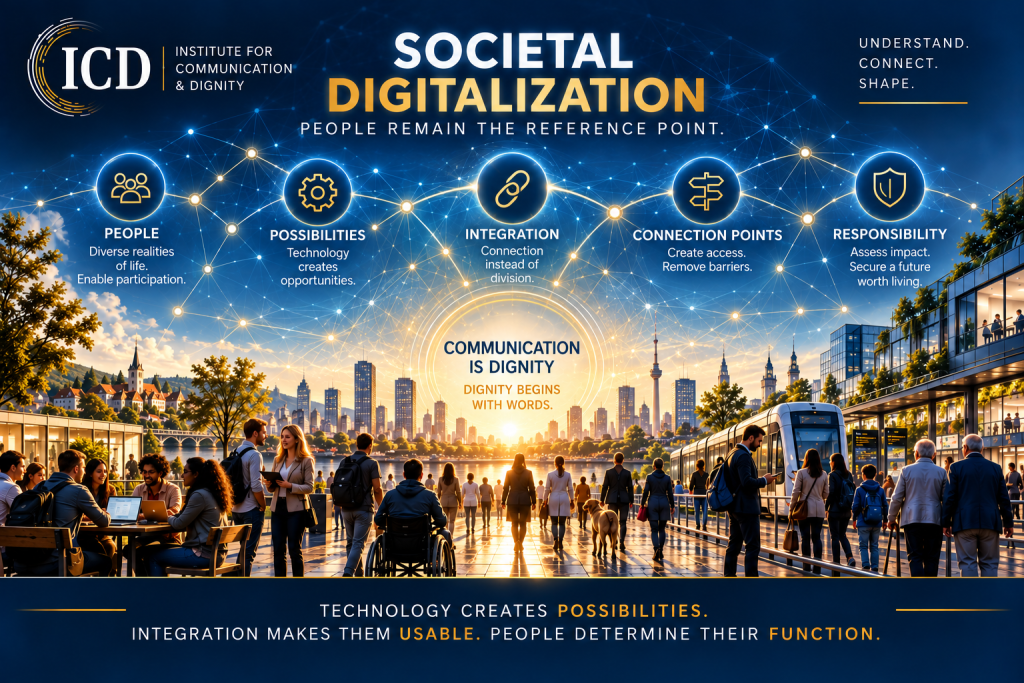
Societal Digitalization
For the ICD, digitalization as a field of activity has evolved into the forward-looking area of societal digitalization.
Digitalization does not only change technical processes. It changes how people communicate, learn, work, find their way and experience social reality.
The ICD considers analogue and digital systems as distinct spaces of human possibility. We do not ask which form is fundamentally superior, but rather what function it serves for people and what impact it has.
Technology can shorten pathways, make information accessible and enable new forms of communication and participation. At the same time, it changes habits, capabilities, relationships and the way people perceive and experience their environment.
Technology creates possibilities. Integration makes them usable. People determine their function.
We are also interested in the transitions between the analogue and digital worlds: Where do both continue to exist side by side? Where do hybrid forms emerge? Where do analogue and digital possibilities combine to create a functional symbiosis?
People Remain the Reference Point
Digitalization is not an end in itself for us. People have different experiences, needs and lived realities. What makes things easier for one person may create a barrier for another.
We therefore approach societal digitalization with an open mind and tolerance for different lived realities. What matters is not the observer’s personal preference, but function, application and actual impact.
Guiding Principle
Not everything that is technically possible has to serve people. What matters is what people do with the possibilities of technology – and what technology does to their lived realities.