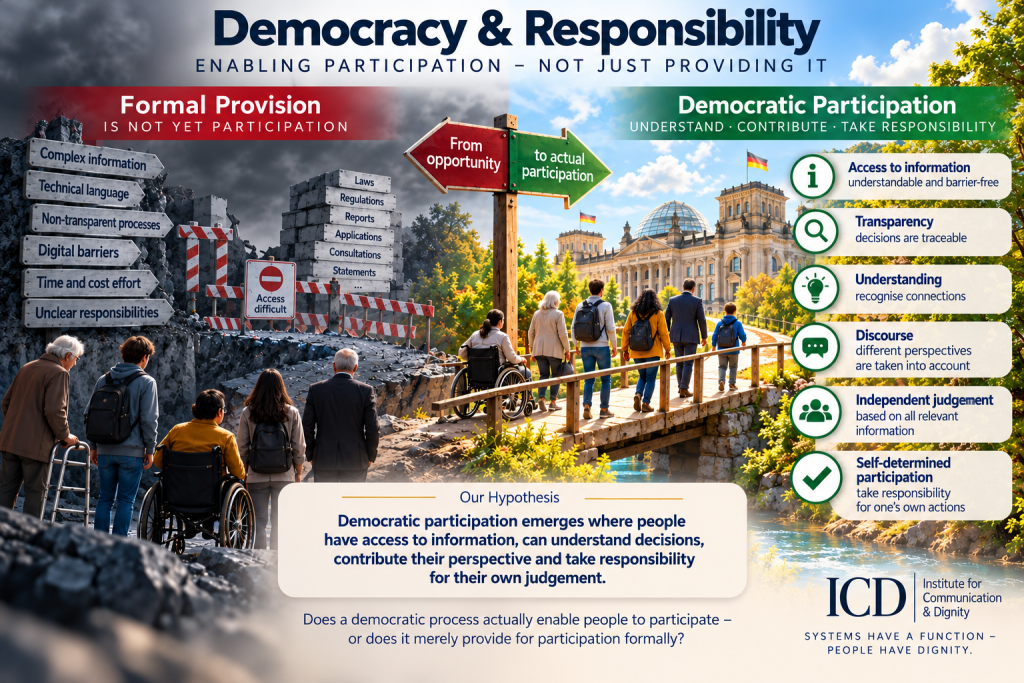
Democracy Requires Participation
Democracy is more than elections, institutions and legally regulated procedures. Its function emerges where people genuinely have the opportunity to understand societal decisions, contribute their interests and take responsibility for their own actions.
Institutions and procedures are tools for this purpose. They are intended to enable and safeguard democratic participation.
From this, the ICD derives a fundamental hypothesis:
The quality of a democratic system is reflected not only in whether participation is formally provided for, but in whether people are actually able to participate.
Formal Opportunity Is Not Yet Participation
Access may exist as a matter of law and still be difficult to use in practice. Information may be publicly available and still remain difficult to understand. Participation procedures may be offered while requiring conditions that effectively exclude some people.
It is therefore not enough to consider only the existence of democratic procedures. What matters is their actual impact.
The possibility of participation does not yet prove its accessibility.
This is precisely where communication becomes a democratic function. People must be able to understand what decisions are being made, who bears responsibility, which interests have been taken into account and how an outcome has been reached.
Transparency Enables Independent Judgement
Democratic transparency does not require people to agree with a decision. Rather, it creates the conditions for them to understand how it came about and form their own judgement.
This creates a chain of effects:
Information → Transparency → Traceability → Understanding → Reasoned Judgement → Self-determined Participation
A democratic system therefore does not say: “Trust us.” It creates conditions under which people can decide for themselves whether and why they develop trust.
Responsibility Must Not Replace the Individual
Participation also means taking people seriously as individuals capable of acting for themselves. Support can remove obstacles, make information accessible and create opportunities for action. But it should not unnecessarily take over decisions that people are capable of making themselves.
Support creates possibilities. Substitution can assume responsibility that should remain with the individual.
A democratic system that respects human dignity therefore does not seek to take over the lives of its citizens. It creates a space of possibilities in which different people can act autonomously.
Democracy Is Discourse
Democracy depends on different interests, experiences and perspectives being able to encounter one another. Its task is not to silence differences, but to provide processes through which those differences can lead to mutual understanding and viable decisions.
A democratic society therefore needs more than people who represent their own positions. It needs structures that enable exchange between different positions.
The defining form of communication in autocracy is the speech. The defining form of communication in democracy is discourse.
Our Hypothesis
Democratic participation emerges where people have access to information, can understand decisions, contribute their perspective and take responsibility for their own judgement.
This leads to our test question:
Does a democratic process actually enable people to participate – or does it merely provide for participation formally?