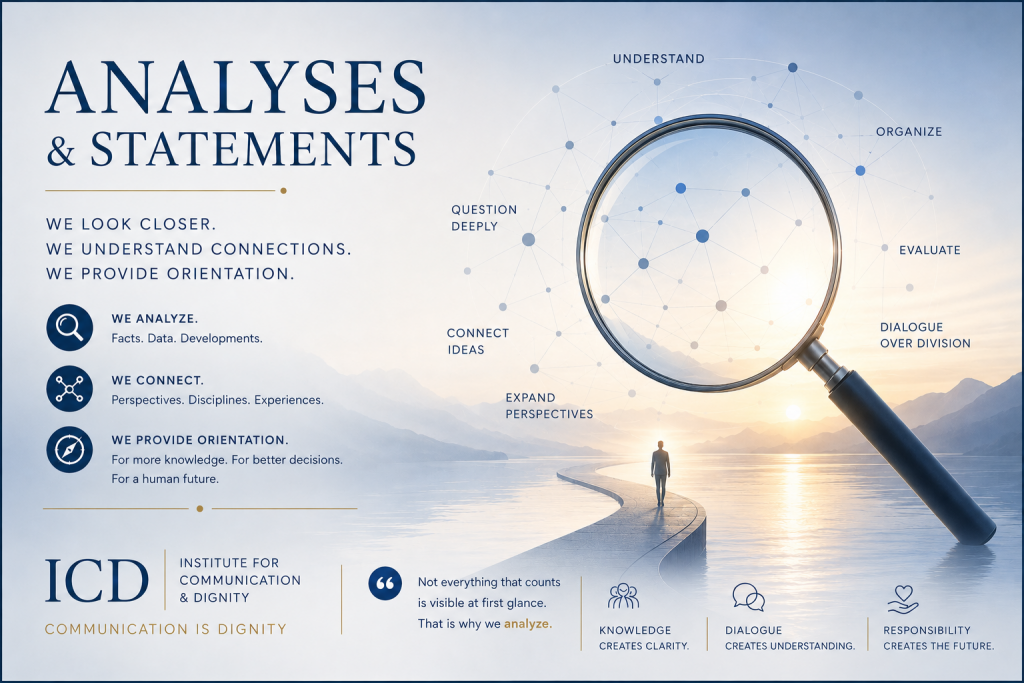
Examining connections – opening perspectives for discourse
The analyses and statements published by the Institute for Communication & Dignity (ICD) are intended as scientifically grounded contributions to reflection on social, legal, ethical, and communicative issues. Their purpose is not to prescribe political positions or evaluate short-term debates. Instead, they examine underlying relationships, question existing structures, and invite different perspectives into an informed and constructive discourse.
We do not understand analysis as a search for a predetermined answer. Insight emerges where observations can be examined, arguments weighed against one another, and our own assumptions remain open to question.
The Institute for Communication & Dignity (ICD) believes that sustainable change begins where arguments become more important than opinions, responsibility more important than assigning blame, and mutual understanding more important than confrontation.
ICD-Statement Law-Language-Responsibility-27-07-2026-ENG – Author: Detlef Leiss
Law and language form two of the essential foundations of every democratic society. Law provides the binding framework for peaceful coexistence, while language enables understanding, trust and meaningful participation.
This statement explores the relationship between legal certainty, social responsibility and human communication. It views the law not merely as a system of rules, but as an instrument for protecting human dignity. At the same time, it reminds us that language loses its unifying power when it is shaped primarily by fear of legal consequences.
The reflections that follow invite readers to consider the shared responsibility of law, language and society—for democracy depends not only on the rule of law, but also on a culture of respectful dialogue.
ICD-Reflexion – Institutional-Oversight-Responsibility- 26-07-2026-ENG – Autor: Detlef Leiss
Independent oversight is one of the fundamental principles of a democratic society governed by the rule of law. It is intended to foster public trust, hold power accountable and ensure that public institutions remain committed to the law and the common good. This reflection explores the importance of responsibility, independence and humanity in effective institutional oversight—and why procedures alone can never guarantee justice.
ICD-Manifest #01 – Digital State 2030 – Author: Detlef Leiss
This ICD Manifest outlines the requirements of a modern Digital State and highlights their relevance for society and democracy.
As society continues to evolve, new challenges and opportunities emerge. Policymakers must address these developments and provide sustainable answers to the questions of the future.
The Digital State 2030 is not merely a technological vision. It is a democratic project aimed at strengthening participation, accessibility, communication, and trust between citizens and public institutions.