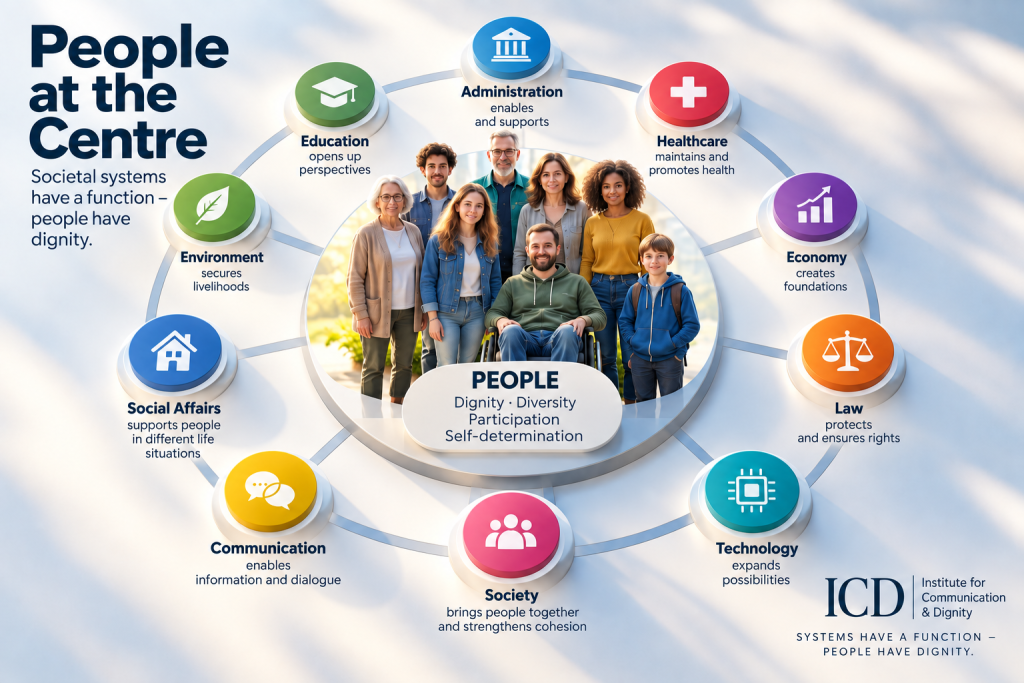
People Are the Reference Point
Societal systems exist because people need to organise how they live together. Public administration, education, medicine, the economy, law and technological systems fulfil different tasks. They have functions – people have dignity.
From this, the ICD derives a fundamental hypothesis:
A system that respects human dignity must be oriented towards real people. It is not people who must prove their suitability for the system, but the system that must prove its function for people.
People differ. They have different abilities, experiences, resources and possibilities. A functioning societal system therefore cannot be based on an idealised person who understands its processes, possesses all the required abilities and can independently compensate for any barriers that arise. The ICD therefore develops approaches that are based not on behavioural ideals, but on resilient and adaptive structures. People & Dignity
Dignity Does Not Have to Be Earned
Human dignity does not arise from achievement, societal benefit or the ability to meet particular requirements. It is inherent in being human. People & Dignity
This is precisely where people differ from systems. A system has no dignity. Its existence is tied to a function. The functionality of a system therefore cannot be judged solely by whether enough people are able to cope with it.
People can overcome barriers, find ways around them or compensate for them through their own efforts. But this does not prove that the barrier does not exist. It initially shows only that people have found ways of dealing with it.
The ICD therefore considers not only the outcome, but also the path leading to it: What does a system require of people? Are these requirements actually necessary for its function? And what effort is required of people in order to achieve the intended goal?
Systems Are Tools
With “People at the Centre”, we do not place one person above another. We make people the reference point of societal systems.
A system that respects human dignity does not take over a person’s life or replace their decisions. It creates the conditions under which people can act autonomously and participate. This is precisely where the distinction between support and substitution lies: support creates possibilities; substitution can assume responsibility that should remain with the person themselves. Democracy & Responsibility
This also changes how we view accessibility. It is then not a special form of assistance for particular groups, but a property of the system itself: An accessible system enables different people to use it for its intended function.
Our Hypothesis
People are the reference point. Their dignity is the boundary. The system is the tool.
This leads to a simple test question:
How would a system need to be designed if its starting point were not the ideal person, but the real person?