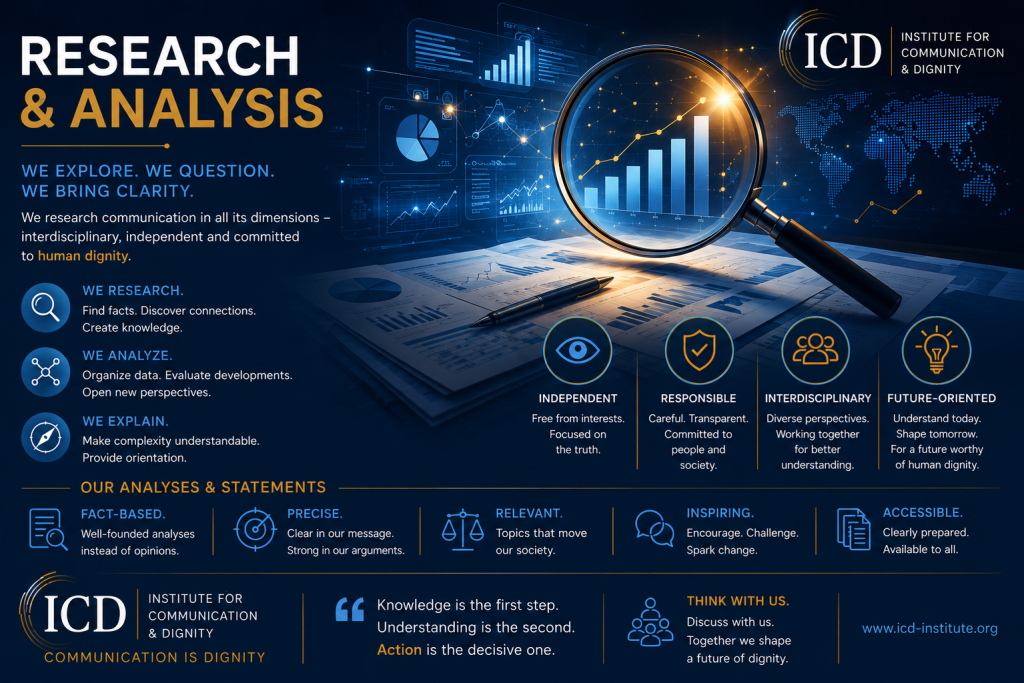
The Institute for Communication & Dignity (ICD) examines communication, social structures and institutional processes in terms of their function and their actual impact on people.
We look not only at individual processes, but also at their underlying conditions, interfaces and chains of effects.
People are the point of reference. Their dignity is the boundary. The system is the tool.
How we conduct our research
Our starting point may be social developments, institutional processes, documented experiences or individual observations.
We ask:
What function is a system intended to fulfil?
What does it require of people?
Are these requirements actually necessary for it to fulfil its function?
And what effects do they have?
We also consider the effort people have to make in order to achieve an intended outcome.
Successful compensation does not prove the absence of a barrier – nor does it prove that a system is functioning properly.
Our methodological cycle
Observation → Reconstruction → Function → Relevant Factor → Impact → Analysis → Change → Renewed Observation
Individual cases are not automatically generalised. They may provide the starting point for a research question through which we examine whether reproducible patterns can be identified.
Science remains open to development
Our findings remain open to scrutiny. We document sources and conclusions, identify uncertainties, and revise or expand our assessments when new evidence makes this necessary.
Scientific knowledge is not an endpoint. New findings, methods, and social or technological developments can expand existing knowledge.
Our goal is not infallibility. Our goal is transparency and traceability.
Research must reach people
Scientific knowledge can only have an impact on society if people have access to it.
We therefore aim to communicate complex relationships clearly and accessibly without losing their scientific substance.
For us, research is therefore more than the production of knowledge. It provides a foundation for further research, public discourse and the continued development of systems.
Goal
Understand what works. Discover why it works.
Create knowledge that can continue to evolve.